
energy encore 8 5.1 surround sound system manual

Energy Encore 8 5․1 Surround Sound System: A Comprehensive Guide

Unlock the full potential of your Energy Encore 8 system! This guide provides essential setup, troubleshooting, and maintenance details for optimal cinematic audio enjoyment․

Welcome to an immersive audio experience! The Energy Encore 8 5․1 surround sound system is designed to deliver high-fidelity sound, bringing your movies, music, and games to life․ This comprehensive system, now part of the Klipsch Group, builds upon Energy’s legacy of quality loudspeakers, founded in 1973․

This manual serves as your guide to maximizing performance and ensuring long-lasting listening satisfaction․ It details proper installation, component connections, and system customization․ Whether you’re a seasoned audiophile or new to surround sound, this resource will help you navigate the features and troubleshoot potential issues․ Downloadable resources and support are readily available to enhance your experience․

System Overview and Components

The Energy Encore 8 5․1 system comprises several key components working in harmony to create a captivating soundstage․ This includes five satellite speakers – designed for precise audio reproduction – and a powerful subwoofer (model ESW-8) delivering deep, resonant bass․ A central channel speaker enhances dialogue clarity, crucial for immersive movie experiences․

The system requires a compatible AV receiver to process audio signals and power the speakers․ While the manual focuses on system operation, receiver-specific instructions are essential for proper setup․ Energy, now under the Klipsch Group, prioritizes quality and performance․ Refer to the included documentation and online resources for detailed component specifications and optimal system configuration․

Setting Up Your Energy Encore 8 System

Proper installation is key! This section details unboxing, speaker placement, and connection procedures, ensuring optimal performance and a truly immersive audio experience․

Unboxing and Component Checklist

Carefully unpack your Energy Encore 8 5․1 system, verifying all components are present․ Your package should include five satellite speakers, a dedicated center channel speaker, and a powerful subwoofer․ Additionally, confirm the receiver manual is included, alongside all necessary speaker wires and the remote control․

Inspect each speaker for any visible damage incurred during shipping․ A quick visual check ensures everything arrived in perfect condition․ Cross-reference the contents with the included documentation to guarantee nothing is missing․ Retain the original packaging for potential future transport or warranty claims․ Proper inventory now prevents frustration later during setup and ensures a seamless audio experience․

Speaker Placement for Optimal Surround Sound

Achieving immersive audio with your Energy Encore 8 hinges on strategic speaker placement․ The goal is to create a soundstage that envelops you, enhancing the cinematic experience․ Consider your room’s dimensions and furniture arrangement when positioning each speaker․ Avoid obstructions that might block sound waves, and prioritize symmetry for balanced audio․

Proper placement isn’t just about location; it’s about angles too․ Experiment with slight adjustments to find the “sweet spot” where sound is clearest and most impactful․ Remember, the manual offers specific recommendations for each speaker type – front, center, surround, and subwoofer – to maximize performance and truly bring your movies and music to life․

Front Speakers: Positioning and Angle

Positioning your Energy Encore 8 front speakers is crucial for a solid soundstage foundation․ Place them equidistant from your primary listening position, flanking your television or projection screen․ Aim for an equilateral triangle – the distance between the speakers should roughly equal the distance from each speaker to you․

Toe-in is key! Gently angle the front speakers inward, directing sound towards the listening area․ Experiment with the degree of toe-in; a slight angle often provides the best balance between focused imaging and a wider soundstage․ The manual details optimal angles based on room acoustics and personal preference, ensuring clarity and impactful sound reproduction․

Center Channel Speaker: Placement Guidelines

The Energy Encore 8 center channel speaker anchors dialogue and crucial on-screen sounds․ Position it directly above or below your television, as close to the screen as possible․ Ensure the front of the speaker is flush with the screen’s edge to maintain accurate audio-visual synchronization․

Avoid obstructions! Do not place objects in front of the center channel, as this can muffle or distort dialogue․ A slight upward or downward tilt may be necessary to direct sound towards the primary listening position․ Refer to the manual for specific angling recommendations based on your setup․ Proper placement dramatically enhances clarity and intelligibility of vocals․

Surround Speakers: Achieving Immersive Audio

Energy Encore 8 surround speakers create a captivating, three-dimensional soundscape․ Position them to the sides and slightly behind the primary listening position, ideally at ear level․ A common setup involves placing them at a 90- to 110-degree angle relative to the center channel․

Diffuse sound is key! Avoid direct line-of-sight between the surround speakers and the listening area․ Wall or ceiling mounting can enhance diffusion, creating a more enveloping experience․ Consult the manual for optimal height and angle adjustments․ Experiment with placement to find the sweet spot for immersive sound effects and ambient audio․

Subwoofer Placement: Finding the Sweet Spot

The Energy Encore 8 subwoofer delivers powerful low-frequency effects․ Placement significantly impacts bass response; experimentation is crucial․ Start by positioning it along a wall, away from corners, to minimize boominess․ The “subwoofer crawl” method is recommended: place the subwoofer at your listening position and crawl around the room to identify where the bass sounds smoothest․

Avoid nulls and peaks! Once located, place the subwoofer in that spot․ Consider room dimensions and furniture placement․ Multiple short-wall placements can sometimes yield better results than a single long-wall position; Refer to the manual for specific guidance and calibration procedures to optimize integration with the other speakers․

Connecting the System

Proper connections are key! This section details connecting speakers to your receiver, calibrating the subwoofer, and linking your favorite source devices seamlessly․

Connecting Speakers to the Receiver

Establishing a solid connection between your Energy Encore 8 speakers and your AV receiver is fundamental for optimal sound quality․ Carefully examine your receiver’s rear panel; you’ll find color-coded terminals corresponding to each speaker channel – front left, front right, center, surround left, surround right, and subwoofer․

Using speaker wire of appropriate gauge (typically 16-18 AWG is recommended), connect each speaker to its designated terminal, ensuring correct polarity (+ to + and – to –); Incorrect polarity can result in phase cancellation and diminished bass response․ Double-check all connections for tightness and security․

Refer to your receiver’s manual for specific wiring diagrams and instructions․ A secure and properly wired connection will lay the groundwork for an immersive and enjoyable surround sound experience with your Energy Encore 8 system․

Subwoofer Connection and Calibration

Proper subwoofer connection and calibration are crucial for impactful bass and a balanced soundstage․ Connect the subwoofer cable from the receiver’s dedicated subwoofer output to the subwoofer’s line-in input․ Ensure a secure connection․

Next, utilize your receiver’s built-in calibration tools – often involving a test tone and microphone – to optimize the subwoofer’s level and crossover frequency․ The crossover determines which frequencies are sent to the subwoofer versus the other speakers․

Experiment with different crossover settings (typically between 80Hz and 120Hz) to find what sounds best in your room․ Adjust the subwoofer’s volume to blend seamlessly with the rest of the system, avoiding overpowering or muddy bass․ Careful calibration unlocks the full potential of your Energy Encore 8’s low-frequency performance․

Connecting Source Devices (Blu-ray, TV, etc․)

Seamlessly integrate your entertainment sources with your Energy Encore 8 system․ Utilize HDMI connections whenever possible for both audio and video, ensuring the highest quality signal transfer; Connect your Blu-ray player, TV, and other devices to the receiver’s HDMI inputs․

For older devices lacking HDMI, employ optical or RCA audio cables, connecting them to the corresponding inputs on the receiver․ Ensure the receiver is set to the correct input source corresponding to each connected device․

Within your receiver’s settings, confirm that audio output is configured for the connected source․ This may involve selecting “Auto” or specifying the audio format (Dolby Digital, DTS)․ Proper connection and configuration unlock the full immersive potential of your system․

Understanding the System Features

Explore advanced functionalities! The Energy Encore 8 supports Dolby and DTS decoding, offering customizable receiver settings for tailored audio experiences and optimal sound․

Decoding Formats Supported (Dolby, DTS)

Immersive Audio Capabilities: The Energy Encore 8 5․1 system is engineered to deliver a truly captivating audio experience through its support of industry-standard decoding formats․ Primarily, this system expertly handles both Dolby and DTS technologies, crucial for reproducing high-fidelity surround sound from Blu-ray discs, streaming services, and other compatible sources․

Dolby Digital and DTS Decoding: These formats enable the system to accurately interpret and distribute audio signals across all five speakers and the subwoofer, creating a realistic and enveloping soundstage․ Proper decoding ensures that sounds are positioned correctly within the listening environment, enhancing the sense of immersion․ The receiver within your system plays a vital role in processing these signals effectively․

Optimizing Decoding Performance: To maximize the benefits of Dolby and DTS, ensure your source device is configured to output these formats․ Refer to your source device’s manual for specific instructions․ The Energy Encore 8 is designed to provide a rich, detailed, and dynamic audio experience when utilizing these advanced decoding capabilities․

Receiver Settings and Customization

Tailoring Sound to Your Space: Your Energy Encore 8 receiver offers extensive customization options to optimize performance for your specific room and listening preferences․ Accessing the receiver’s settings menu allows you to fine-tune various parameters, ensuring the best possible audio quality․

Key Customization Areas: Explore settings for speaker configuration (defining size and distance), audio processing modes (selecting Dolby or DTS), and equalization․ Adjusting these settings allows you to compensate for room acoustics and personal sound preferences․ Careful calibration is key to unlocking the system’s full potential․

Advanced Settings: Further customization includes crossover settings, which determine which frequencies are sent to each speaker, and dynamic range control, which manages the difference between loud and quiet sounds․ Experiment with these settings to achieve a balanced and immersive sound experience perfectly suited to your environment․

Adjusting Speaker Levels

Achieving Balance: Proper speaker level calibration is crucial for a truly immersive surround sound experience with your Energy Encore 8 system․ The goal is to ensure each speaker contributes equally to the overall soundstage, creating a balanced and natural audio environment․

Utilizing the Receiver’s Tools: Most receivers include a built-in sound level meter or microphone calibration system․ This tool plays test tones through each speaker while you adjust the individual output levels until they are consistent․ Manual adjustment is also possible, relying on your ears to identify imbalances․

Fine-Tuning for Optimal Sound: Pay close attention to the center channel, ensuring dialogue is clear and prominent․ Surround speakers should be set at a lower level, creating an enveloping effect without overpowering the front soundstage․ Consistent levels create a cohesive and realistic listening experience․

Crossover Settings Explained

Understanding Crossover Frequency: Crossover settings determine which frequencies are sent to your Energy Encore 8 speakers versus the subwoofer․ This is vital for seamless audio integration and optimal performance․ A correctly set crossover ensures a smooth transition between speakers, avoiding gaps or overlaps in the frequency response․

Setting the Right Frequency: Typically, a crossover point between 80Hz and 120Hz is recommended for most 5․1 systems․ Lower frequencies are handled by the subwoofer, while higher frequencies are directed to the satellite speakers․ Experimentation is key, as room acoustics and speaker capabilities influence the ideal setting․

Receiver Configuration: Access your receiver’s settings menu to adjust the crossover frequency for each speaker channel․ Start with a moderate setting and fine-tune based on listening tests, aiming for clear, balanced sound across the entire frequency spectrum․

Equalization and Sound Modes

Fine-Tuning Your Audio: The Energy Encore 8 receiver offers equalization (EQ) and preset sound modes to tailor the audio to your preferences and content․ EQ allows you to adjust specific frequency ranges, boosting or reducing them to correct room acoustics or personal taste․

Preset Sound Modes: Explore the available sound modes like “Movie,” “Music,” “Game,” and “Direct․” These presets optimize the audio settings for specific content types, providing a more immersive and enjoyable listening experience․ “Direct” mode bypasses all processing for a pure, unaltered sound․

Custom EQ Settings: For advanced users, custom EQ settings provide granular control over the audio․ Experiment with different settings to achieve the desired sound signature, ensuring balanced and clear audio reproduction throughout your listening space․

Troubleshooting Common Issues

Resolve audio problems quickly! This section details solutions for no sound, distortion, subwoofer malfunctions, and remote control difficulties with your Energy Encore 8․

No Sound Troubleshooting

Experiencing silence? Begin by verifying the receiver’s power and input selection․ Ensure all speaker wires are securely connected to both the receiver and the speakers themselves – a loose connection is a frequent culprit․ Double-check the volume level on both the receiver and the source device (Blu-ray player, TV, etc․)․

Next, confirm the receiver is set to the correct decoding mode (Dolby, DTS) for the audio source․ If using a TV, verify its audio output settings are configured for external speakers․ Test each speaker individually using the receiver’s speaker test function to identify any potentially faulty components․ Finally, consult the receiver’s manual for specific troubleshooting steps related to no audio output․

Distorted Sound Solutions

Hearing crackling or unclear audio? First, lower the volume level on both the receiver and the source device; excessive volume can cause distortion․ Inspect speaker wires for damage or fraying, replacing them if necessary․ Verify that the speaker impedance matches the receiver’s specifications – mismatched impedance can lead to distortion․

Check the receiver’s crossover settings, ensuring they are appropriately configured for each speaker․ Experiment with different equalization (EQ) settings to fine-tune the sound and reduce harsh frequencies․ If distortion persists with only one speaker, that speaker may be damaged and require repair or replacement․ Consult the receiver’s manual for advanced troubleshooting options․

Subwoofer Not Working: Diagnosis

No bass? Let’s troubleshoot! First, confirm the subwoofer is powered on and the power cable is securely connected․ Check the RCA cable connecting the subwoofer to the receiver; ensure it’s firmly plugged in at both ends․ Verify the receiver is sending a signal to the subwoofer – use the receiver’s speaker test function․

Adjust the subwoofer’s volume and crossover settings; a low volume or incorrect crossover can prevent sound output․ Try a different RCA cable to rule out a faulty connection․ If still silent, test the subwoofer with another receiver if possible․ A failing amplifier within the subwoofer itself may be the issue, requiring professional repair․

Remote Control Issues and Solutions

Frustrated with the remote? Begin by replacing the batteries with fresh ones, ensuring correct polarity․ Aim the remote directly at the receiver’s infrared sensor, unobstructed․ If it still doesn’t respond, try resetting the remote by removing the batteries for several minutes, then reinserting them․

Check for interference from other electronic devices or bright sunlight․ Some remotes require pairing with the receiver; consult your receiver’s manual for pairing instructions; If the remote is damaged (buttons sticky or unresponsive), it may need replacement․ Explore universal remotes as a convenient alternative, programmable for multiple devices․

Maintenance and Care

Preserve your investment! Regularly clean speakers with a soft cloth and store them properly when not in use, following warranty guidelines for support․

Cleaning Your Energy Encore 8 Speakers

Maintaining the pristine condition of your Energy Encore 8 speakers is crucial for both aesthetics and optimal sound quality․ Dust accumulation can subtly impact performance, so regular cleaning is recommended․ Always begin by disconnecting the speakers from the receiver to ensure safety․

Use a soft, dry cloth to gently wipe down the speaker enclosures․ Avoid abrasive cleaners or solvents, as these can damage the finish․ For stubborn grime, lightly dampen the cloth with a mild detergent solution – ensuring it’s wrung out thoroughly to prevent moisture from entering the speaker components․

Pay particular attention to the speaker grilles, carefully removing any dust buildup․ Vacuuming with a soft brush attachment can be effective․ Never use liquids directly on the grilles․ For the woofer and tweeter cones, a very gentle dusting is sufficient; avoid touching them directly․ Consistent, careful cleaning will extend the life and preserve the beauty of your Energy Encore 8 system․

Long-Term Storage Guidelines

If you plan to store your Energy Encore 8 5․1 system for an extended period, proper preparation is essential to prevent damage and ensure future functionality․ Begin by thoroughly cleaning the speakers, as detailed in the maintenance section, to remove dust and debris․

Carefully disconnect all cables and store them separately, labeled for easy re-connection․ Ideally, store the speakers in their original packaging, providing maximum protection against physical impacts and environmental factors․ If original packaging isn’t available, use sturdy boxes with ample padding․

Choose a cool, dry location, away from direct sunlight, extreme temperatures, and humidity․ Avoid storage areas prone to pests or mold․ Periodically check the stored equipment for any signs of deterioration․ Following these guidelines will help preserve your investment and guarantee a seamless return to immersive audio when you’re ready․

Warranty Information and Support

Your Energy Encore 8 5․1 system is covered by a limited warranty against defects in materials and workmanship․ The warranty period typically begins from the date of original purchase, and proof of purchase is required for all claims․

Specific warranty terms, including duration and coverage details, are outlined in the separate warranty document included with your system․ Please retain this document for your records․ For warranty service or support inquiries, contact Klipsch Group, the current owner of Energy loudspeakers․

Visit the Klipsch Group Support Website (see Resources section) for detailed contact information, FAQs, and online support resources․ They offer assistance with troubleshooting, parts replacement, and warranty claim processing․ Ensure you have your model number and serial number readily available when contacting support․

Resources and Further Information

Explore the Energy Speaker System Manual Archive and the Klipsch Group Support Website for additional documentation, FAQs, and expert assistance․

Energy Speaker System Manual Archive

Delve into our comprehensive archive of Energy speaker system manuals, offering a wealth of information for both current and legacy products․ This resource is meticulously curated to provide users with easy access to detailed guides, specifications, and troubleshooting tips․

Locate the official Energy Encore 8 5․1 surround sound system manual alongside documentation for other Energy models․ We strive to maintain a complete collection, ensuring you can find the support you need to optimize your listening experience․

All files are provided under strict license, prohibiting reproduction for financial gain․ Consider donating copies of additional documentation to expand our free archive and benefit the wider community of Energy speaker enthusiasts․

Klipsch Group Support Website

For dedicated support and resources regarding your Energy Encore 8 5․1 system, visit the official Klipsch Group support website․ As Energy is now part of the Klipsch Group, their platform serves as the primary hub for assistance․

Explore a comprehensive knowledge base, frequently asked questions, and troubleshooting guides tailored to Energy products․ You can also access downloadable manuals, including the Energy Encore 8 5․1 surround sound system manual, and submit support requests directly to their team․

Benefit from expert assistance and ensure your system operates at peak performance․ The Klipsch Group website is your go-to destination for all Energy-related support needs․

11 pin relay wiring diagram pdf

11-Pin relays offer versatile control, managing three load circuits concurrently; resources like wiring diagrams and manuals aid installation and understanding of their functionality.

These relays, often detailed in PDF guides, are crucial for various applications, from simple automation to complex industrial systems, offering robust switching capabilities.

What is an 11-Pin Relay?

An 11-Pin relay is an electromechanical switch, boasting eleven connection points, designed to control multiple circuits with a single activation signal. Unlike simpler relays, it provides the capability to switch up to three separate loads simultaneously, making it ideal for complex applications.

Detailed 11-Pin relay wiring diagrams, often found in PDF format, illustrate the relay’s internal structure and pin functions. These diagrams are essential for understanding how to properly connect power, control signals, and loads. The relay operates by energizing a coil, which then mechanically alters the connections between the pins, effectively opening or closing circuits.
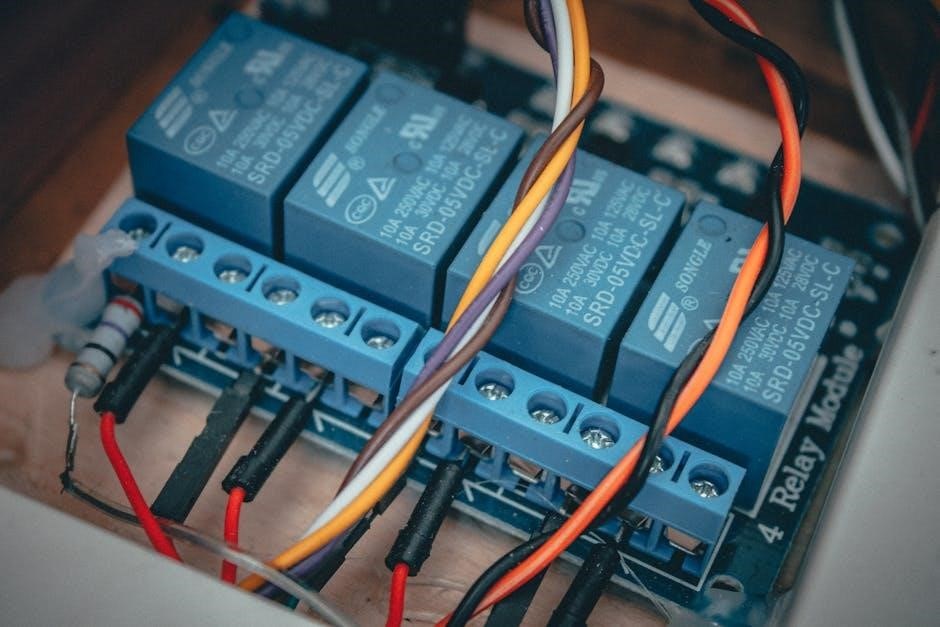
These relays are commonly used in automotive, industrial automation, and control systems where multiple devices need coordinated switching. Understanding the pinout, as shown in available PDFs, is critical for successful implementation and troubleshooting.

Common Applications of 11-Pin Relays

11-Pin relays find extensive use in automotive applications, controlling headlights, auxiliary lights, and other high-current devices. Industrial automation leverages them for managing multiple actuators, motors, and sensors within a system. Control systems benefit from their ability to switch several loads with a single control signal, simplifying wiring and logic.

Accessing a 11-Pin relay wiring diagram PDF is crucial for implementing these applications correctly. They are also utilized in robotics, where precise control of multiple components is essential. The relay’s capacity to handle multiple circuits reduces the need for numerous individual switches, streamlining designs.

Furthermore, these relays are found in security systems, powering alarms, locks, and lighting. Proper wiring, guided by detailed diagrams, ensures reliable operation and safety in these critical applications.

Understanding the 11-Pin Relay Pinout

Pinout diagrams, often found in PDF manuals, detail connections for coil control and load switching; understanding these is vital for correct 11-Pin relay operation.

Pin Numbering Convention

Pin numbering on 11-Pin relays generally follows a standardized convention, crucial for interpreting wiring diagrams and PDF documentation. Typically, numbering proceeds sequentially, often clockwise or counter-clockwise when viewing the relay socket.

However, manufacturers may vary slightly, so always consult the specific datasheet or wiring diagram PDF for your relay model. Common conventions start with Pin 1 near a locating tab or marker on the socket. Identifying the coil pins (for power activation) and the load pins (for switching circuits) is paramount.

PDF guides frequently illustrate this numbering scheme, clarifying which pin controls the relay and which connect to the loads. Accurate pin identification prevents incorrect wiring and potential damage to the relay or connected devices. Understanding this convention is the first step towards successful implementation.

Detailed Pin Descriptions (Common, Normally Open, Normally Closed)

11-Pin relays utilize three distinct contact types: Common (COM), Normally Open (NO), and Normally Closed (NC). The Common pin serves as the switching point. When the relay is energized, it connects to either the NO or NC pin, depending on the circuit.

Normally Open contacts are disconnected in their resting state; applying power to the relay coil closes the circuit, connecting COM to NO. Conversely, Normally Closed contacts are connected when the relay is off, and disconnect when energized, linking COM to NC.

Wiring diagram PDFs clearly label these pins, essential for configuring circuits. Understanding these states is vital for controlling loads – switching them on or off based on the relay’s activation. Correct identification prevents circuit malfunctions and ensures safe operation.

Basic 11-Pin Relay Wiring Concepts

Relay wiring involves supplying coil voltage, connecting the common terminal, and utilizing normally open or closed contacts, as shown in diagrams.

Power Supply Requirements

Understanding power supply needs is vital when working with 11-Pin relays. These relays require a DC power source to energize the coil, activating the switching mechanism. PDF wiring diagrams typically specify the required voltage, commonly 12V or 24V DC, but variations exist.

The power supply must provide sufficient current to the relay coil; insufficient current prevents proper activation. Diagrams often indicate the coil’s current draw. Using a power supply with a higher voltage than specified can damage the relay, while a lower voltage may result in unreliable operation. Always consult the relay’s datasheet, often available as a PDF, for precise power requirements and ensure the power supply is appropriately fused for safety.

Coil Voltage and Current

Coil voltage and current are critical parameters for 11-Pin relay operation. Wiring diagrams, often found in PDF format, detail the specific voltage needed to energize the relay’s coil – typically 5V, 12V, or 24V DC. Applying the wrong voltage can cause malfunction or damage.

Current draw is equally important; exceeding the coil’s rated current can lead to overheating and failure. PDF datasheets specify the coil’s resistance, allowing calculation of the required current using Ohm’s Law. Ensure the power supply delivers the correct current. A resistor may be needed to limit current if the supply voltage is higher than the coil’s rated voltage. Always prioritize matching the coil’s specifications for reliable performance and longevity.

PLA Type 11-Pin Relay Wiring Diagrams

PLA type relays utilize specific wiring diagrams, often available as PDF documents, detailing connections for latching, holding circuits, and standard configurations for optimal control.

Standard PLA Relay Configuration

Standard PLA relay configurations, frequently illustrated in 11-pin relay wiring diagram PDF guides, typically involve connecting the coil to a power source through a control signal. This energizes the coil, activating the internal switch mechanisms.

The common pin then connects to either the power source or the load, depending on the desired operation. Normally open (NO) contacts close, completing the circuit to the load when the relay is energized, while normally closed (NC) contacts open.

These diagrams emphasize proper grounding and wire gauge selection for safe and reliable operation. Understanding this basic setup, often found in manufacturer datasheets, is crucial for successful implementation and troubleshooting. Detailed PDF resources provide visual clarity for these connections.

Latching/Holding Circuit Wiring

Latching or holding circuits, detailed in many 11-pin relay wiring diagram PDF resources, maintain relay activation even after the initial trigger signal is removed. This is achieved by incorporating a feedback loop, utilizing auxiliary contacts on the relay itself.

When the relay energizes, these auxiliary contacts close, providing a sustained current path to the coil, effectively “latching” it in the activated state. PDF guides often illustrate this using normally open (NO) contacts wired to maintain the coil’s power supply.

These circuits are ideal for applications requiring persistent operation without continuous signal input. Careful attention to voltage and current ratings, as shown in the diagrams, is vital for reliable latching functionality and preventing coil burnout.

Wiring for Controlling Multiple Loads

11-Pin relays, as shown in wiring diagram PDF guides, excel at simultaneously controlling three independent load circuits, enhancing system efficiency and simplifying wiring.

Utilizing the Three Load Circuits

11-Pin relays uniquely provide three separate load circuits, significantly expanding their control capabilities. Detailed wiring diagram PDFs illustrate how to harness this feature for diverse applications. Each circuit operates independently, allowing simultaneous control of multiple devices from a single relay activation.

These circuits can be configured as Normally Open (NO) or Normally Closed (NC), offering flexibility in design. A PDF guide will demonstrate connecting loads to either NO contacts for activation upon relay energization, or NC contacts for deactivation. This versatility makes them ideal for complex automation, industrial control systems, and projects requiring multiple switched outputs. Understanding the diagram is key to maximizing the relay’s potential.

Properly utilizing all three circuits streamlines wiring, reduces component count, and enhances overall system efficiency, as shown in available documentation.

Connecting Loads to Normally Open (NO) Contacts

Normally Open (NO) contacts on an 11-Pin relay are disconnected in their resting state, completing the circuit only when the relay is energized. Wiring diagram PDFs clearly illustrate this connection method, showing the load connected in series with the NO contact and the power source.

This configuration is ideal for applications where you want a device to activate upon relay activation – think lights, motors, or solenoids. The PDF guides emphasize ensuring the load’s voltage and current requirements are within the relay’s contact ratings to prevent damage. Correct wiring, as depicted in the diagram, is crucial for safe and reliable operation.

Referencing a detailed diagram ensures proper polarity and secure connections, maximizing the relay’s lifespan and preventing potential hazards.

Wiring for Normally Closed (NC) Contacts

NC contacts, detailed in wiring diagram PDFs, are closed when the relay is off, opening upon activation; ideal for safety circuits and alarms.

Applications of NC Contacts

Normally Closed (NC) contacts find extensive use in safety-critical systems, offering a fail-safe mechanism. Wiring diagram PDFs illustrate how NC contacts maintain a circuit’s continuity during normal operation, immediately breaking it upon relay activation. This is vital in emergency shutdown systems, where power loss triggers a safe state.

Furthermore, NC contacts are frequently employed in alarm circuits; a breach or trigger activates the relay, opening the circuit and signaling an alert. They’re also valuable in control systems requiring a default-on state, like maintaining a valve’s open position until a specific condition necessitates closure. Detailed 11-pin relay wiring diagrams showcase these applications, emphasizing the importance of proper configuration for reliable operation and safety.

Understanding NC contact behavior, as depicted in these diagrams, is crucial for effective system design.

Safety Considerations with NC Wiring

NC wiring demands careful attention to safety, as it inherently assumes a powered state. Wiring diagram PDFs often highlight the need for robust insulation and proper grounding to prevent accidental energization of connected loads. Incorrect wiring can lead to unexpected operation or, worse, electrical hazards.

Always verify the relay’s specifications and ensure compatibility with the load’s voltage and current requirements. When troubleshooting, de-energize the circuit completely before making any connections or modifications. 11-pin relay wiring diagrams should be consulted to confirm correct polarity and contact configuration. Ignoring these precautions can compromise system integrity and pose a significant risk of electrical shock or equipment damage. Prioritize safety by adhering to established electrical codes and best practices.

Regular inspection of wiring is also essential.

Relay Socket Connections (SUB08-A & SUB11-A)

Sockets SUB08-A & SUB11-A simplify installation, offering a secure connection point for 11-pin relays; wiring diagram PDFs detail their pinout compatibility.

Socket Pinout and Compatibility

Relay sockets, specifically SUB08-A and SUB11-A, are designed for seamless integration with various 11-pin relays, streamlining installation and maintenance. Detailed wiring diagram PDFs illustrate the precise pin mapping for each socket, ensuring correct connections for coil power, common terminals, and normally open/closed contacts.

Compatibility is key; these sockets accommodate a range of relay manufacturers and specifications. The diagrams clearly show how each pin on the relay aligns with the corresponding socket terminal. Utilizing these sockets eliminates the need for direct wiring, reducing potential errors and simplifying relay replacement. Always consult the PDF documentation to verify compatibility with your specific relay model and ensure proper functionality. Proper alignment is crucial for reliable operation and preventing damage.

Using Relay Sockets for Easy Installation

Relay sockets, like SUB08-A and SUB11-A, significantly simplify the installation process of 11-pin relays. Instead of directly wiring the relay, a wiring diagram PDF guides you to connect wires to the socket, then simply plug in the relay. This approach minimizes wiring complexity and reduces the risk of incorrect connections.

Furthermore, sockets facilitate easy relay replacement. If a relay fails, it can be quickly swapped without disturbing the existing wiring. Detailed PDF guides showcase the socket’s pinout, ensuring correct orientation. This is particularly beneficial in applications requiring frequent maintenance or experimentation. Using sockets also protects the relay terminals from physical stress, extending its lifespan and improving overall system reliability. Consult the diagram for optimal results.

Safety Precautions When Wiring 11-Pin Relays

Always disconnect power before wiring, use proper grounding techniques, and consult a wiring diagram PDF to avoid electrical shock hazards during installation.

Electrical Shock Hazards

Working with 11-Pin relays involves electrical circuits, presenting significant shock hazards if safety precautions aren’t strictly followed. Always disconnect the power supply before making any connections or disconnections; this is paramount. Even with the power off, capacitors can retain a charge, so discharge them appropriately.

Referencing a detailed 11-Pin relay wiring diagram PDF is crucial, but it doesn’t replace safe work practices. Never handle wiring with wet hands or while standing on a damp surface. Ensure proper insulation of all exposed wires and connections. Incorrect wiring, as shown in some diagrams, can create short circuits and increase shock risk.

If you are unfamiliar with electrical work, consult a qualified electrician. Ignoring these precautions can lead to severe injury or even fatality. Prioritize safety above all else when dealing with these components.

Proper Grounding Techniques

Effective grounding is essential when working with 11-Pin relays to minimize electrical shock hazards and ensure proper circuit operation. A solid earth ground provides a safe path for fault currents, preventing dangerous voltage buildup. Consult your 11-Pin relay wiring diagram PDF to identify designated grounding points, typically marked with the ground symbol.

Use appropriately sized grounding wires and ensure secure connections to the grounding system. Avoid using gas pipes or water pipes as grounding conductors, as they may not provide a reliable path. Proper grounding also helps reduce electrical noise and interference, improving the relay’s performance.

Regularly inspect grounding connections for corrosion or looseness. A well-grounded system, combined with careful wiring based on the diagram, significantly enhances safety and reliability.

Troubleshooting Common 11-Pin Relay Wiring Issues

Refer to your 11-Pin relay wiring diagram PDF to diagnose activation or switching problems; verify coil voltage and load connections for correct operation.

Relay Not Activating

If the 11-Pin relay fails to activate, meticulously consult your relay wiring diagram PDF. Begin by verifying the power supply to the relay coil; ensure correct voltage and polarity are present. A common issue is a loose connection or a blown fuse in the control circuit.

Next, check the coil resistance using a multimeter – a significant deviation from the specified value indicates a faulty coil. Confirm the control signal is reaching the relay; if using a switch or sensor, test its functionality independently.

Also, examine the grounding connection; a poor ground can prevent proper activation. Finally, review the diagram to ensure the coil is wired correctly and that any holding circuits (if present) are functioning as intended. A damaged relay coil is often the root cause.

Incorrect Load Switching

When loads aren’t switching as expected, your 11-Pin relay wiring diagram PDF becomes essential. First, double-check the wiring to the Normally Open (NO) and Normally Closed (NC) contacts. A swapped connection is a frequent cause of incorrect operation.

Verify the load’s voltage and current requirements align with the relay’s contact ratings; exceeding these limits can cause contact failure or erratic behavior. Inspect the contacts themselves for signs of burning or pitting, indicating wear or damage.

Confirm the control signal is correctly activating the relay, as a partially energized relay might lead to inconsistent switching. Refer to the diagram to ensure proper load connections and troubleshoot any wiring errors meticulously.

Resources for 11-Pin Relay Diagrams and Information

Online forums, manufacturer datasheets, and readily available PDF wiring diagrams provide invaluable support for understanding and troubleshooting 11-Pin relay applications.

Online Forums and Communities

Engaging with online forums dedicated to electronics and automation provides a dynamic platform for accessing 11-Pin relay expertise. Numerous communities, like the 11 Plus Exams Forum (though primarily focused on education, it demonstrates community support), host threads discussing specific wiring challenges and solutions.

Users frequently share PDF wiring diagrams, personal experiences, and troubleshooting tips. These forums are invaluable for deciphering complex schematics and gaining practical insights beyond manufacturer documentation. Searching for “11 pin relay wiring diagram pdf” within these communities often yields relevant results. Active participation allows you to ask targeted questions and benefit from collective knowledge, accelerating your understanding and project success; Remember to verify information from multiple sources.

Manufacturer Datasheets and Documentation

Reliable 11-Pin relay information begins with the manufacturer’s official datasheets. These documents, often available as PDF downloads from the manufacturer’s website, contain precise pinout diagrams, coil specifications, and recommended wiring configurations. They detail safety certifications like EN 60947-1 and EN 61810-1, ensuring compliance and safe operation.

Datasheets provide crucial details regarding power supply requirements, contact ratings, and operating characteristics. While potentially technical, they are the most accurate source for understanding your specific relay model. Searching for the relay’s part number alongside “datasheet” or “wiring diagram pdf” will typically locate the relevant documentation. Always prioritize manufacturer data over generalized online resources for critical applications.